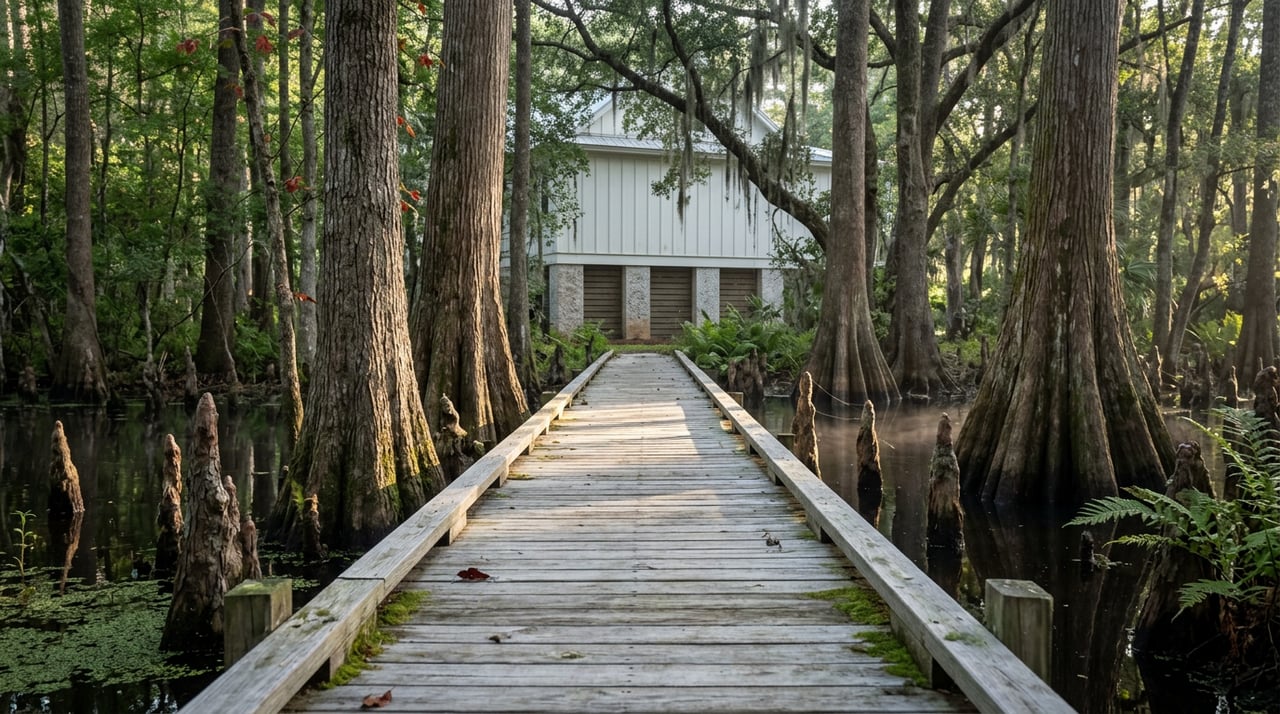
Every resident who drives past the marker for Whooping Crane Pond Conservancy has probably wondered, at least once, what is actually back there behind the tree line. The gate at the entrance to Hilton Head Plantation gets all the attention. This second, quieter threshold, marked by a small sign and a boardwalk disappearing into black gum and tupelo, gets almost none. Most residents walk past it a hundred times before they ever step onto the boards.
What is easy to miss is that this swamp, and its smaller cousin a few streets over, should not really still be here in the shape they are. Freshwater wetlands on a barrier island depend on rain, and Hilton Head's rain does not fall evenly enough to keep 137 acres of black gum swamp saturated year round. The reason Whooping Crane Pond Conservancy and Cypress Conservancy have stayed wet, wooded, and full of the wildlife residents come to see is that they have had help since 1986, when the Hilton Head Public Service District began piping in treated reclaimed water to keep both conservancies from drying out. That single decision is the reason the boardwalk experience most residents take for granted still exists at all.
Two Conservancies, One Piece of Infrastructure
The Hilton Head Island Land Trust monitors and protects both properties, and both sit fully inside Hilton Head Plantation's gates. Whooping Crane Pond Conservancy covers 137 acres, formed as a shallow valley between old shoreline dunes. Its habitat mix runs from freshwater black gum and tupelo swamp to open savannah swamp, with a transition zone of dense, head high shrubs separating the wetland from the drier pine uplands. That range of habitat is why the property supports roughly 75 plant species and 100 wildlife species according to the Land Trust's own accounting.
Cypress Conservancy is smaller at 51 acres, but it holds something Whooping Crane Pond does not. It contains the only remaining, naturally occurring stand of bald cypress on Hilton Head Island. These are the same family of tree as coastal redwoods and giant sequoias, just built for wet feet instead of dry mountainsides. The Land Trust counts about 70 plant species and 115 wildlife species across the property.
Both conservancies rely on the same reclaimed water system, and that system does more than keep the trees alive. It also gives the neighborhood a working flood buffer. The wetlands absorb millions of gallons of stormwater every year, which means every rainstorm that Whooping Crane Pond and Cypress Conservancy soak up is water that is not pooling in a driveway or backing up a drainage ditch somewhere else in Hilton Head Plantation. Residents who think of these conservancies purely as scenery are missing half of what they actually do for the community.
What's Actually Along the Boardwalk
At Whooping Crane Pond, the walk has two distinct legs. The first is the Nancy Cathcart Path, which winds through dry pine forest before connecting to the elevated boardwalk proper. That boardwalk runs 1,100 feet into the heart of the swamp, engineered to carry walkers over standing water and soft ground without disturbing either. Three additional trails branch off to give further views into the different habitat zones, from the pine uplands down into the swamp edge itself.
Cypress Conservancy's boardwalk is shorter but has a clear destination. It weaves through the wetland and ends at the stand of bald cypress, with interpretive signage identifying species along the way. Anyone who has spent time in the Lowcountry has seen bald cypress in postcards. Fewer residents realize that this particular stand is the last naturally occurring one left on the island, which makes the walk to it less like a nature stroll and more like a visit to something that could not be recreated somewhere else if it were lost.
The Detail That Catches New Residents Off Guard
Both conservancies are restricted to residents of Hilton Head Plantation and Sea Pines. That is not a minor technicality. Visitors and even Land Trust members who live outside those two communities need to arrange a tour in advance rather than walking in on their own, and hikers from outside the gates have been turned away at the guard station when they tried. For residents, this means the boardwalks function almost like a private amenity, closer in spirit to a community pool than a public park, even though the Land Trust rather than the plantation's association manages the land itself.
The other detail worth knowing before a first visit is more practical. Pets are not permitted on the boardwalk. It is an easy rule to miss if you are used to walking a dog through Hilton Head Plantation on leash without a second thought, and it exists to protect ground nesting birds and the swamp floor itself rather than out of any concern about dogs specifically.
If You Want to Bring Someone Who Doesn't Live Here
Guests visiting for the weekend who are not Hilton Head Plantation or Sea Pines residents will not be able to walk either conservancy boardwalk on their own. The nearest public alternative sits directly across the street from the plantation. Jarvis Creek Park has its own walking trail circling a freshwater lake, along with a fishing dock and picnic space, and it gives non resident guests a comparable freshwater walk without needing gate access. It is a reasonable stand in for an afternoon, even if it does not include the bald cypress stand or the Land Trust's interpretive signage.
What This Actually Adds Up To
None of this is really about the plants, at least not entirely. It is about what it means to live somewhere where a piece of working water infrastructure has been quietly dressed up as a walking trail for four decades. The reclaimed water system that keeps Whooping Crane Pond and Cypress Conservancy wet was built to solve a practical problem, not to create a resident amenity, and the fact that it did both at once is the kind of detail that only becomes visible once you know to look for it. The next time a heavy rain rolls through and the street in front of your house stays dry longer than you expect, some of the credit belongs to the swamp down the road.
For residents who have lived in Hilton Head Plantation for years without walking either boardwalk, late summer and early fall are a reasonable time to finally go. Water levels are usually easier to read, and the transition zones between pine upland and swamp edge show the layered habitat structure more clearly than in the thick of a wet spring. Whether the destination is the 1,100 foot boardwalk through Whooping Crane Pond or the shorter walk to Cypress Conservancy's bald cypress stand, both are already paid for, already maintained, and already sitting behind a gate most residents pass every single day.
If you are weighing a move into Hilton Head Plantation, or already live here and are curious what else sits quietly behind the plantation's gates, Debra Reece has spent years learning the details that do not show up in a listing photo. Let's Connect.