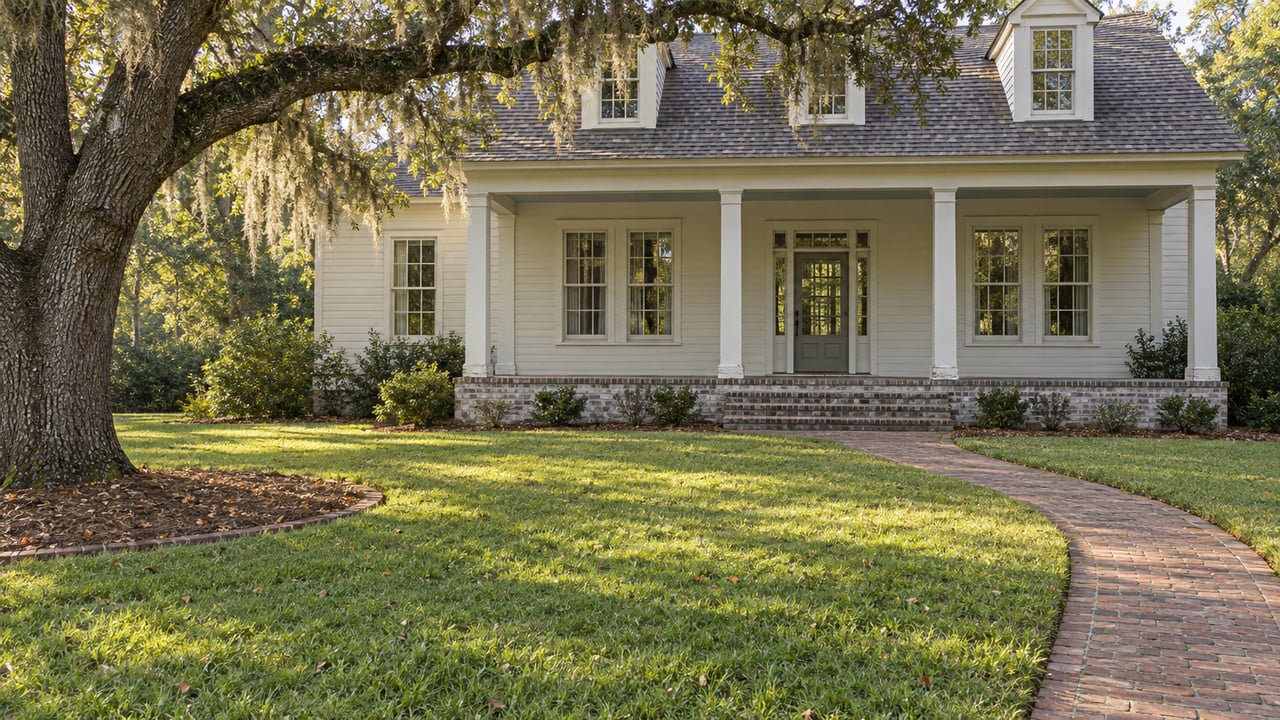
The Town of Hilton Head Island announced work on its newest park in March. In that release, Ford's Shell Rings and Green's are grouped as two of the island's three shell-ring sites. The South Carolina Department of Natural Resources dates them differently. The Ford's rings are roughly 4,000 years old. SCDNR's radiocarbon date for the shell embankment at Green's is approximately 1335 CE, which makes it younger than the Ford's rings by more than three thousand years. Both sites sit along Squire Pope Road, which runs north from US 278 toward Hilton Head Plantation's Cypress Gate. As of October 16, both are open for a walk.
A short drive down a familiar road covers a stretch of island history longer than most of Europe's.
What opened at 273 Squire Pope Road
Ford's Shell Ring Park takes up 6.8 wooded waterfront acres at 273 Squire Pope Road. It is named for the land's last private owner, Henry Ford. In 2003 the Town of Hilton Head Island and Beaufort County bought the parcel for $3.95 million to keep two 4,000-year-old shell rings out of development. Beaufort County Council voted unanimously in 2020 to build a passive park around them.
The rings are shaped like a figure eight. According to Beaufort County's opening announcement, Ford's was the first site found where two shell rings adjoin, and it is listed on the National Register of Historic Places. The Town's March release expected construction to finish by the end of July. The ribbon was cut on Friday, October 16. The Town, the County and the Hilton Head chapter of the Archaeological Society of South Carolina held the event together, and a docent-led tour followed.
At the ceremony, Mayor Alan Perry told WSAV that the site is somewhere people can "not only learn but actually take a moment of reprieve and to relax and just to enjoy the surroundings that we have."
The Town's March release planned a light build. Contractors were to use low-impact methods to keep excavation and clearing to a minimum. The plan called for earth trails, earthen drives, split-rail fencing, vehicle gates and interpretive signs. The same release notes that the rings are protected under Town code, which makes it illegal to damage or disturb historic and archaeological sites.
A ring is older, and stranger, than it looks
Beaufort County's definition sets a shell ring apart from an ordinary pile of shells. Indigenous people on coastal areas and barrier islands built them during the Late Archaic Period. Shell middens are heaps, and these deposits form concentric shapes.
The Ford's rings contain hundreds of thousands of discarded oyster, clam and mussel shells, along with animal bones. Archaeologists still don't agree on why they were built. One theory holds that they were circular villages and the shells piled up from daily meals. Another holds that they were gathering places for ceremonies, and the shell deposits are what remains of large communal feasts.
The site may hold more than the rings. David Gordon, president of the Archaeological Society's Hilton Head Island Chapter, told WSAV at the opening that the rings may not be the only finds there:
"There's much more that can be explored in this site. And we're looking forward to other archeologists coming in and doing more work so we can know more about these interesting people from very, very long ago."
Green's was built as a defense
Green's Shell Enclosure Heritage Preserve is a different kind of place. It covers three acres on the marsh edge beside Skull Creek. SCDNR's Heritage Trust Program and the South Carolina Department of Parks, Recreation and Tourism acquired it in 1991. The Town and SCDNR own it jointly, and Heritage Trust manages it.
The feature itself is a shell embankment a little over one meter high and about ten meters across. SCDNR places it in the Irene phase of the Mississippian Period, which ran from 1300 to 1450 CE. Excavations turned up stone flakes left from toolmaking and deer bones worn into the shape of needles. They also found pottery sherds with paddle stamping, incising, punctations and appliques, decorations specific to the Irene phase. Comparing Green's with other Irene-phase sites, SCDNR concludes it most likely protected a village with walls, palisades and ditches. The SC Trails listing calls it a fortified village built by farmers. Green's has been on the National Register since 1974.
So the two sites face each other across a long stretch of time. Ford's is a pair of Archaic rings whose purpose is still debated: village, feast ground, or both. Green's is a much later defensive enclosure built by a farming society that made decorated pottery.
| Ford's Shell Ring Park | Green's Shell Enclosure Heritage Preserve | |
|---|---|---|
| Age | Roughly 4,000 years | Approximately 1335 CE |
| Period | Late Archaic | Irene phase, Mississippian Period |
| Form | Two adjoining rings in a figure eight | Shell embankment about 1 m high, about 10 m across |
| Likely purpose | Debated: circular village or ceremonial feasting site | Defensive enclosure for a village |
| Size of site | 6.8 acres | 3 acres |
| Protected since | 2003 purchase by Town and County | 1991 acquisition by SCDNR and SCPRT |
| National Register | Listed | Listed 1974 |
| Owners | Bought jointly by the Town of Hilton Head Island and Beaufort County | Owned jointly by the Town and SCDNR, managed by Heritage Trust |
Walking both in one morning
Both sites are small and both are off Squire Pope Road, so one unhurried morning covers them easily. Visiting them in date order makes the time gap easier to feel.
Start at Ford's, 273 Squire Pope Road. On opening day there was no on-site parking. Guests parked at 133 Squire Pope Road and took a shuttle, but that arrangement was for the ceremony only. The Town's parks listing now shows Ford's with free parking, a trail and historical features. Photos on the Town's park page show a welcome sign, a mulch path through the woods, a bench facing a large old tree by the water, and two interpretive panels. One panel is titled "Archaic Shell Ring" and the other "Historic Gullah Communities." The signs cover Indigenous lifeways and the Gullah Geechee heritage of the island's coastal communities along with the rings.
Then drive to Greens Park for the preserve. The SC Trails directions start at the intersection of US 278 and Squire Pope Road. Head north on Squire Pope and turn left into Greens Park. Pass the office on your left, and the preserve entrance is on the left at a gate. Go around the gate and follow the road past a cemetery to the entrance ramp. The trail is an easy 0.20-mile round trip on a natural surface. It ends at an overlook, and from the viewing platform you can see the shell feature just below.
Know the preserve rules before you go. SCDNR's preserve page says Green's opens only during daylight hours and has a small parking area. The same page prohibits hunting, any vehicles including bicycles, camping and horseback riding. It also bans collecting or damaging artifacts, fossils, plants and other natural or cultural material. SC Trails asks visitors to stay on the trail and recommends insect repellent in warm months.
If you finish the morning still thinking about shell, the island's third shell-ring site is in the Sea Pines Forest Preserve.
Why the difference matters on a Saturday walk
Seeing the two sites back to back changes what a shell bank in the marsh means. The figure eight at Ford's comes from people who lived here long before farming reached the coast, and nobody has settled what the shape was for. The embankment at Green's was built by a society that grew crops, made decorated pottery and had reason to defend a village beside Skull Creek. Both sites lie within a short drive of each other, on a road that ends at Hilton Head Plantation's Cypress Gate.
Guided interpretation is offered here too. On October 12, the Coastal Discovery Museum ran two tour sessions at Green's with SCDNR archaeologist Meg Gaillard. Registration was required, and the sessions covered the preserve's Indigenous history, archaeological research and recent excavations. Those sessions have passed. Given the Archaeological Society's hopes for more fieldwork at Ford's, its excursions page is worth checking again.
Ford's and Green's join a longer list of north-end places that reward a closer look, from the Skull Creek side of the back gate to the boardwalk conservancies inside the gates. More on the community itself is on our Hilton Head Plantation neighborhood page.
If you walk Ford's this fall and want to talk about the north end, from the history along Squire Pope Road to the daily routines inside the gate, I'd be glad to hear what you found. Debra Reece works with Hilton Head Plantation residents and newcomers who care about the place as much as the property. Let's Connect.