"We are grateful for every moment we get to spend in Port Royal Plantation and on the island."
That's resident Laurence Zenezini, describing a typical week inside the gates: pickleball or tennis, yoga at the Beach House, sunrise walks on the sand. It's the version of Port Royal life most people already know, because it's the version every write-up leads with. Buried a few lines further into that same neighborhood profile is a shorter mention, easy to skim past: a community garden near the tennis and pickleball courts, called Fish Haul Farm, where landowners keep their own plots.
Most residents who drive past it on the way to the courts probably just call it "the garden." That's fine. But the fact that it has an actual name, and that almost nobody uses it, is the first clue that this amenity works differently than people assume.
Ask three sources how big it is, and you'll get three answers
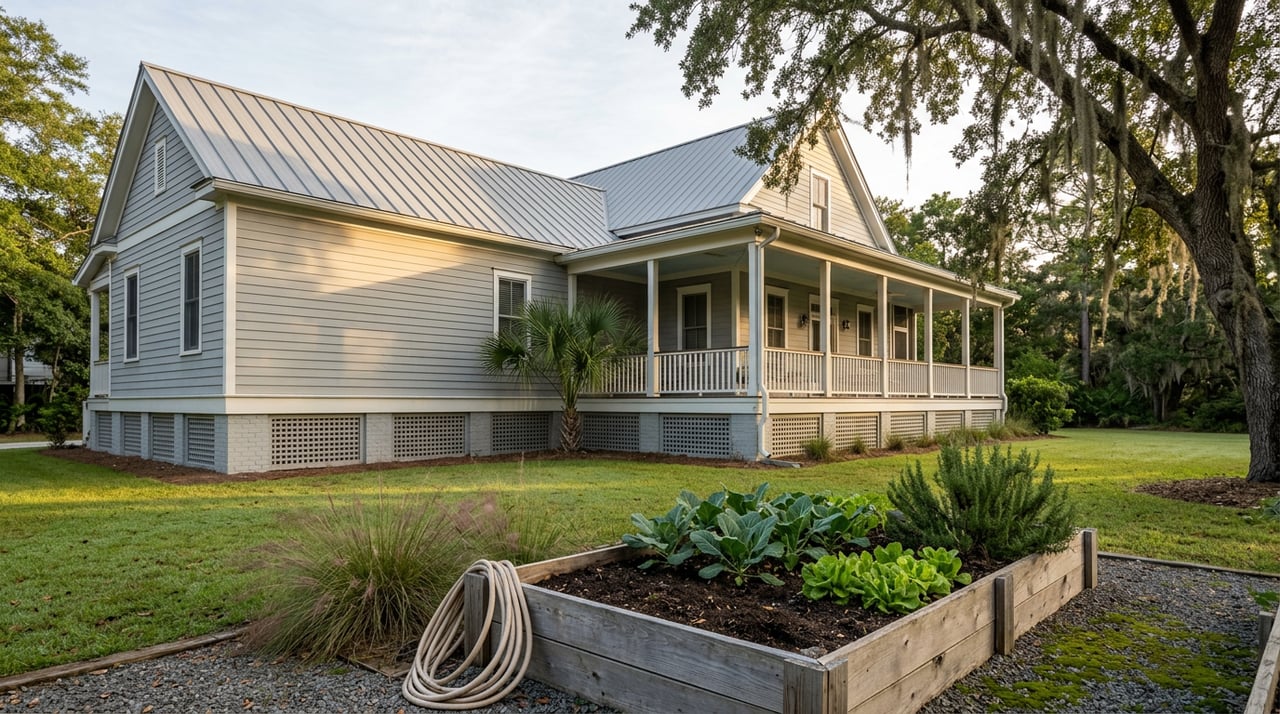
Look up Port Royal Plantation's community garden across a handful of local real estate write-ups and you'll find real disagreement. One describes a fenced garden with 78 individual plots running along the inland marshes, where residents grow produce, flowers, and herbs. Another, focused on the golf and racquet complex, describes something smaller and more structured: 47 raised planter beds next to the clubhouse, including dedicated organic plots and a shed for supplies.
Those aren't necessarily contradictory. They're more likely describing two different sections of the same fenced acreage that grew at different times, in different styles. Raised beds near the clubhouse, in-ground rows further out toward the marsh. A shed for tools and organic amendments near one end, open ground for whoever wants a bigger plot near the other. Gardens like this rarely arrive all at once. They get added to, section by section, as more neighbors want in.
What's consistent across every account is the culture around it. Neighbors trade tips. Harvest gets shared over the fence line. Garden club meetings show up on the same community calendar as bridge nights and tennis round-robins, part of the informal social structure that fills in the space where a resort community would otherwise have paid staff running the show.
What this time of year actually looks like
By early September, most Lowcountry vegetable beds are past their summer run of tomatoes and peppers and turning over to the fall planting window: greens, brassicas, root vegetables that can handle a mild coastal winter. Fish Haul Farm follows the same calendar as any other raised bed on the island. If you haven't walked past it lately, this is the stretch where plots get cleared, amended, and replanted, and where the shed sees more traffic than it did in July.
It's a small, unglamorous rhythm. No ribbon cuttings, no newsletter blast. Just neighbors showing up on weekend mornings with a wheelbarrow.
The quiet model versus the working farm up the road
The contrast gets sharper when you look at Hilton Head Plantation, a few minutes north across the island's north end. Its community garden, Seabrook Farm, is organized under something called the HHP Farmers Club, and it operates less like a shared plot and more like an actual small farm. There are 216 plots, each 25 feet by 25 feet, spread across 300 members. Growers there tend eight kinds of citrus, plus blueberries, figs, apples, peaches, and pecans, alongside common plots of onions, potatoes, beans, corn, squash, and flowers grown specifically for sale. The club keeps bee hives. It holds nine potluck dinners a year with periodic "Back Porch Seminars" on growing technique, and every fall the property owners' association runs a hayride through the farm with costumed kids riding along while someone explains what's in the ground. The harvest gets sold at an actual farmers market, Saturdays in May, June, and July, and again in November and December.
Fish Haul Farm has none of that. No market days. No bee colonies. No hayride. Just plots, a shed, and a garden club that meets when it meets.
That's not a knock on either community. It's a difference in design.
Why the difference fits
Port Royal Plantation is built around the absence of commercial activity. No hotels behind the gates, no short-term rentals, no vendor traffic. The community's own materials describe it as the island's only fully private oceanfront residential community for exactly that reason: nothing here is set up to serve visitors or generate revenue, because there aren't supposed to be visitors to serve. The garden is a small, accurate reflection of that same choice. It exists so residents can grow their own food and get to know their neighbors, not so the neighborhood can run a market stand or host tour groups.
The annual property owners' association assessment, which sat at roughly $3,800 per year as of 2024, covers the garden along with gate security, the Beach House, the arboretum, and the leisure paths. It's treated as one line item among many rather than a standalone attraction, which tracks with how quietly it operates. Compare that to a garden organized as its own club with its own market calendar and its own membership roster, and you're looking at two very different ideas about what a shared amenity is for. One is built to produce a surplus and share it outward. The other is built to stay exactly the size it needs to be for the people who already live there.
If you want the fuller rundown of what else falls under that same private, no-commercial-traffic model, from the Beach House to the arboretum to the leisure trails, the community's amenities and lifestyle overview covers the rest of it in more detail than one garden can.
The next few weekends
If you've got a plot at Fish Haul Farm, this is the stretch to be out there. If you don't and you've been curious, garden club meetings are the easiest way in, and the club culture here runs on exactly the kind of casual, over-the-fence introduction that got Zenezini and plenty of other residents talking about gratitude in the first place. It's a small piece of Port Royal, but it's a genuine one, and it's staying that size on purpose.
If you're weighing a move into Port Royal Plantation or comparing it against a neighborhood like Hilton Head Plantation, the differences run deeper than golf courses and price tags. They show up in details like this one: how a community chooses to run its smallest, least glamorous amenity says a lot about what it values. Debra Reece has spent years helping buyers understand exactly this kind of texture before they commit to a gate code. Let's Connect if you'd like to talk through which side of that comparison fits your own list.